

1. Best AI Content Strategies: Topical Authority Isn't an SEO Tactic Anymore. It's Table Stakes.
If you've been treating AI content topical authority as a nice-to-have ranking signal, the moment to recalibrate was probably 2019. Today it's the structural foundation that determines whether your site shows up in search results or gets skipped entirely - and AI content either accelerates that structure or exposes the absence of it.
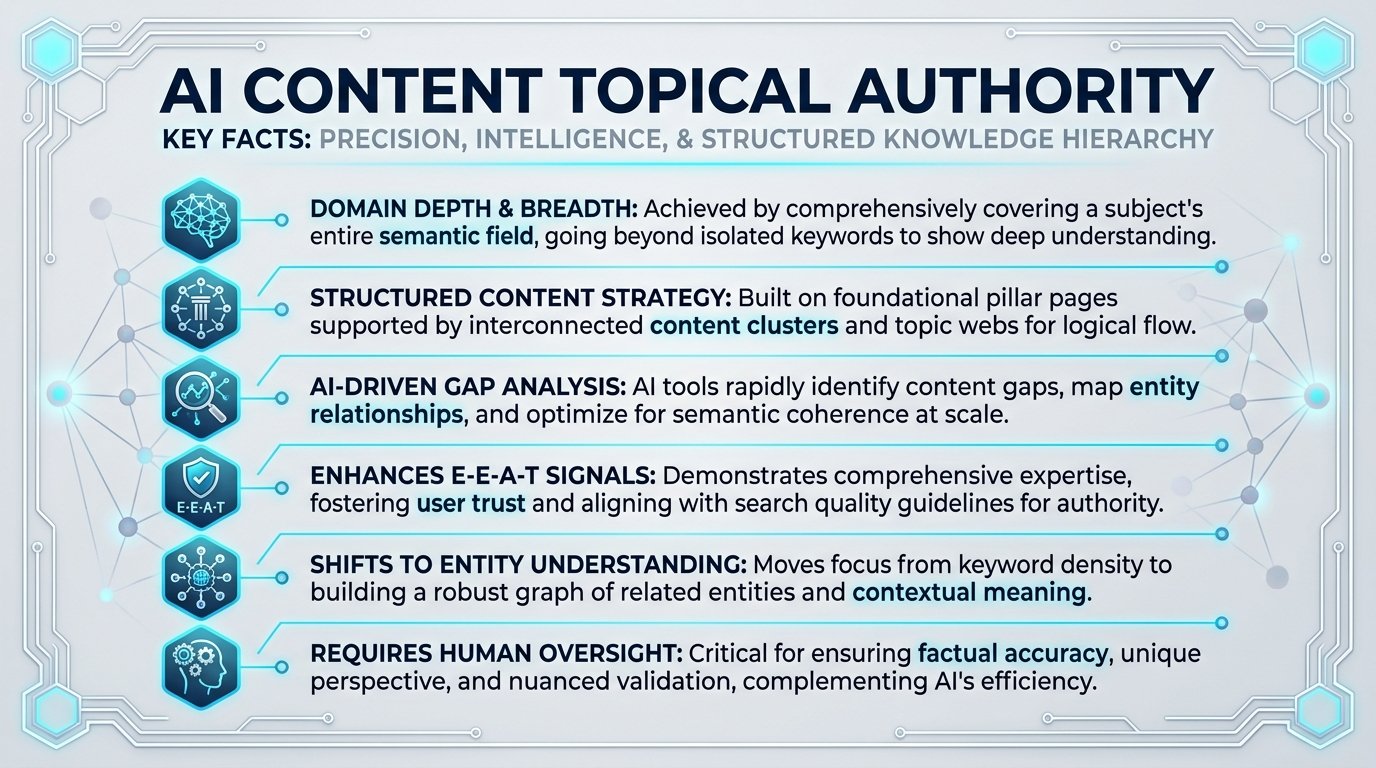
In 2019, Google's BERT update rewired how rankings work. Not gradually. The engine stopped matching keywords and started reading context, which meant isolated articles - no matter how carefully optimized - started losing ground to sites with dense, interlinked clusters covering a subject from every angle.
The patent that explains everything
Google's 2012 patent (US8458196B1) introduced the "Authority Signature Value," a dynamic per-author, per-topic score calculated by multiplying authorship percentage by topic weight within documents. The part most SEOs miss: content sitting outside a recognized topical cluster "may be skipped entirely, regardless of other quality signals.
" That sentence should land differently once you've watched a well-written article stall out for months because nothing else on the domain backed it up.
Structure beats quality when structure is absent. A single polished AI-generated article sitting alone on your domain gets outranked by mediocre content nested inside a 25-article cluster. Worth sitting with.
Why AI Overviews made this urgent
Generative search synthesizes answers directly from indexed sources. Wikipedia captures 11.22% of all AI Overview citations; the top 20 domains hold 66.18% collectively (which is a remarkably concentrated market, if you consider what it means to be outside that group).
If your site lacks the topical density to register as an authority, you're invisible in both traditional results and the AI layer sitting on top of them.
The race isn't to publish more. It's about building depth faster than competitors who are already building it.
2. Map your entire topic universe before you write a single article
AI-powered keyword tools can surface your complete topic universe in hours, a process that used to take content teams weeks of manual research and spreadsheet wrangling.

The biggest mistake teams make when building AI content topical authority is skipping the architecture phase. They generate articles on whatever keywords look promising, scatter them across a blog, and wonder why rankings stagnate. The fix starts with mapping.
Surface the questions your audience actually asks
AlsoAsked and AnswerThePublic pull high-intent questions directly from search behavior data. They show you not just what people search, but how those searches connect to each other - which gives you cluster raw material, not a random topic list.
Feed your core topic in, export everything, and you'll have 50-200 subtopics by end of afternoon (sometimes faster, honestly).
- AlsoAsked: Maps "People Also Ask" chains to reveal question hierarchies
- AnswerThePublic: Visualizes question patterns around a seed keyword
- Keyword Insights: Compares your coverage versus 30+ competitors on a 0-100 topical authority scale
Group keywords into hub-and-spoke clusters
Once you have the raw list, group related keywords into clusters. Each cluster gets one hub article on the foundational topic, supported by 3-5 spoke articles addressing specific subtopics. Every spoke links back to the hub. Every hub links out to its spokes.
The threshold that actually triggers results: 25 interlinked articles per cluster, minimum. Not 10, not 24.
A U.S. health supplement site validated this with a 60.99% organic traffic increase after hitting that structural threshold. Sites reaching 25 articles typically see 40-70% keyword ranking gains within 3-6 months.
Twenty-five isolated articles, by contrast, get you roughly nothing - the gains come from the linking structure, not the raw count.
Planning tip: 25 isolated articles produce negligible results. The gains come from 25 articles that each link to related cluster members, creating the topical density Google's algorithm rewards.
3. Three ways AI closes content gaps your competitors don't even see
AI tools compress weeks of competitor analysis into hours by scanning coverage across dozens of domains simultaneously, showing exactly where your topical map has holes.
Content gap analysis is where the speed advantage shows up most clearly. Manually auditing what 30 competitors cover across hundreds of subtopics isn't just slow - it's practically impossible to do consistently. AI makes it routine.
Run competitor coverage comparisons at scale
Keyword Insights compares your site against 30+ competitor domains and scores topical authority on a 0-100 scale. Not just a missing keywords list.
The output is a map of which subtopics competitors have claimed and which ones sit completely open - that map becomes your publishing priority list, and the content calendar stops being a guess.
Generate structural drafts, then add what AI can't
AI is fast, consistent, and tireless at producing structural first drafts. That part's real. But purely AI-generated content represents only 3% of organic search results, per Graphite's research, and it generally ranks below human-assisted content. Honestly, worth knowing before you go all-in on unedited output.
"The gap between 'we publish a lot' and 'we rank well' is usually not a volume problem."
The differentiator isn't AI versus human. It's commodity output versus AI-assisted content enriched with proprietary data, original case studies, or practitioner experience someone actually lived through. The draft is easy. The information gain - the specific thing a reader can't get from anywhere else - is what ranks.
Why the 3% stat makes human oversight non-negotiable
If purely AI content barely registers in organic results, the implication runs one direction: AI is a production accelerator, not a substitute for editorial judgment. The teams winning at AI content topical authority demonstrate some of the best ai content strategies—they use AI for the 70% of content creation that's structural, then put human effort where it actually moves rankings.
- AI handles: Research synthesis, outline generation, first drafts, internal link mapping
- Humans add: Proprietary data, original analysis, practitioner quotes, unique frameworks
- Result: Content that publishes 3-5x faster while carrying the experience signals Google rewards
4. Four more tactics that compound your topical authority edge
Internal linking architecture, platform diversification, entity optimization, and direct-traffic strategies each multiply the authority you've built through content clusters.

The first three tactics build the foundation. These four accelerate the compounding.
Enforce hub-and-spoke internal linking with AI
The Authority Flow Principle concentrates link equity into topically important hubs, which then push authority outward to supporting spoke content. AI tools can audit your entire site and flag three common linking failures:
- Orphaned content: Articles with zero inbound links from cluster siblings
- Random cross-linking: Links connecting unrelated topic clusters, diluting authority signals
- Generic anchor text: "Click here" or "read more" instead of contextual, topic-relevant phrases
Every spoke article should link to its hub with descriptive anchor text. Every hub should link to every spoke. AI can run this check across hundreds of articles in minutes, catching gaps a manual audit would miss.
Use LinkedIn and YouTube as AI Overview citation platforms
YouTube holds 9.51% of all AI Overview citations - second only to Wikipedia. LinkedIn carries disproportionate weight for thought leadership content. These platforms aren't alternatives to your website strategy; they're citation amplifiers.
Platform AI Overview Citation Share Best Content Type
Wikipedia 11.22% Reference definitions
YouTube 9.51% Tutorials, deep dives
LinkedIn High (top 20) Thought leadership, case studies
Your domain Varies Deep cluster content
Repurpose your hub articles into YouTube videos and LinkedIn posts. You're not building new content from scratch - you're placing the same topical authority across the platforms generative search engines pull from most.
Drive AI referral traffic through entity optimization
One documented case hit a 2,300% monthly AI referral traffic increase through entity optimization and structured data integration. That's not a typo.
Entity optimization means defining the people, places, concepts, and relationships within your content using schema markup - when generative engines parse your pages, structured data removes ambiguity, and your content gets cited because it's easier to read.
- Add schema markup to every hub and spoke article (Article, FAQPage, HowTo)
- Define entities explicitly rather than relying on inference
- Connect entities across articles to reinforce your topical graph
Pair topical authority with a direct-traffic strategy
Here's the uncomfortable part about AI citations: only 1% of them produce actual clicks to the cited source.
Citation volume without a traffic capture strategy produces impressions, not revenue. Layering a newsletter, email list, or community on top of your topical content means that when someone encounters your brand through an AI Overview or a YouTube citation, there's a path to a real relationship. Topical authority gets you seen. Direct traffic gets you paid.
Fastest impact tactic
Internal linking audit with AI tools. Most sites have orphaned content already published that's contributing zero authority to its cluster.
Highest long-term ceiling
Entity optimization plus structured data. The 2,300% AI referral traffic increase shows this is where the best ai content strategies are heading in generative search.
5. Budgets, timelines, and red flags worth knowing
Building a 25-article topical cluster realistically takes 3-6 months, costs between $99 and $1,999 per month in tooling, and breaks down when teams chase cosmetic shortcuts instead of structural depth.

Which tool tier fits your budget
Tier Monthly Cost What You Get Best For
Starter $99-299 Question research (AlsoAsked, AnswerThePublic). Manual cluster organization required. Solo operators, small teams
Professional $599-1,999 Automated gap analysis, competitor benchmarking, internal linking audits (Keyword Insights, SEMrush, HOTH) Content teams scaling cluster production
The starter tier gets you raw research. The professional tier automates the analysis and linking architecture that would otherwise eat 10-15 hours per week of manual work. Both tiers are legitimate starting points - the difference is how much of that structural analysis you're doing by hand.
How long the 25-article cluster actually takes
Plan for 3-6 months from first publish to measurable ranking movement when executing an AI content topical authority strategy. AI compresses per-article production significantly. The timeline doesn't shrink, though - it reflects Google's indexing and evaluation cycles, not your writing speed. You can't shortcut the algorithm's clock.
The learning curve for cluster architecture and internal linking strategy runs 1-2 weeks for practitioners new to topical authority. That's the ramp. After that, the sustained work is building the cluster itself.
Red flags that signal cosmetic SEO, not structural depth
- "Instant topical authority": Topical authority is structural. Anything promising instant results is selling something else.
- No cluster threshold guidance: If a tool doesn't mention the 25-article minimum, it wasn't designed for topical authority.
- Volume without linking: Publishing 50 articles with no internal linking architecture produces 50 orphaned pages, not a cluster.
- No competitor benchmarking: You can't build authority faster than competitors if you can't see what they've already covered.
6. Frequently Asked Questions
What is AI content topical authority?
AI content topical authority is the process of using AI tools to build comprehensive, interlinked content clusters that signal deep subject-matter expertise to search engines. It combines AI-accelerated production with strategic cluster architecture to establish domain authority faster than manual methods allow.
How many articles do you need to build topical authority in a cluster?
The evidence-backed threshold is 25 interlinked articles per cluster. Sites that hit this minimum with proper hub-and-spoke linking typically see 40-70% keyword ranking gains within 3-6 months. Fewer articles, or articles with no internal linking structure, rarely produce measurable authority signals.
How does AI help you build topical authority faster than competitors?
AI tools compress the research, gap analysis, and drafting phases that once took weeks into hours. They can scan 30+ competitor domains simultaneously, identify uncovered subtopics, and generate structural drafts - letting small teams publish cluster-depth content at a pace previously only possible for large editorial operations.
Does purely AI-generated content rank well in search results?
Purely AI-generated content represents only about 3% of organic search results and generally ranks below human-assisted content. AI works best as a production accelerator for structure and drafts, with human editors adding proprietary data, original analysis, and experience signals that search engines reward.
How long does it take to see results from an AI content topical authority strategy?
Expect 3-6 months from first publish to measurable ranking movement. AI speeds up content production, but Google's indexing and evaluation cycles determine when authority signals register. The cluster architecture and internal linking must be in place before the timeline begins to compress meaningfully.
Building AI content topical authority isn't a hack. It's the same structural work that's always driven rankings, just executed at a pace that wasn't possible three years ago - by teams small enough to actually move fast.
The teams pulling ahead aren't the ones publishing the most. They mapped the full topic, built the cluster, linked it properly, and let AI handle the parts that don't require a human brain. That's the real competitive advantage. It compounds every month you keep building.

Write better. Rank higher. Save time.
Article Lab helps you research, plan, and optimize content that actually performs.
Article Lab Team
Writing on content strategy, SEO methodology, and the architecture behind research-driven publishing.