


1. The rise of AI detectors: 4 million searches and a trust crisis
An estimated four million people search for ai content detectors every month. That number isn't a curiosity. It's a distress signal from an internet where nobody can tell what's real anymore.
Synthetic content exploded. That's the simple version. What actually happened is that the flood of AI-generated text online moved fast enough to reshape how ordinary people read and second-guess everything from news articles to product reviews - which pushed readers, hiring managers, teachers, and editors toward detection tools as their only available lifeline.
What those four million searchers are about to discover, though: the tools don't work the way they think. The gap between demand and reliability is the real story.
Who's searching and why
Distinct groups. Wildly different motivations. Educators want to catch student plagiarism; hiring managers want to verify writing samples before extending an offer; content teams are auditing freelancer submissions at a scale that would've seemed unimaginable five years ago. Consumers, meanwhile, just want to know if the review they're reading is real - a surprisingly modest ask that the internet no longer reliably delivers.
Threads across ai content detectors reddit communities tell the rest of the story. Students are terrified of false accusations. Freelancers run their own work through free tools preemptively, which is a kind of absurdist ritual that would've seemed paranoid two years ago. Marketing teams are benchmarking competitors, which is either savvy or pointless depending on how much you trust the tools doing the benchmarking.
The 2025 Checkr survey of 3,000 American consumers confirmed what the Reddit threads suggested: anxiety about deepfakes, AI-generated reviews, and synthetic social profiles is actually changing how people make purchasing and hiring decisions. Not academic concern - behavioral change. Real, measurable, happening now.
2. What do AI content detectors look for?
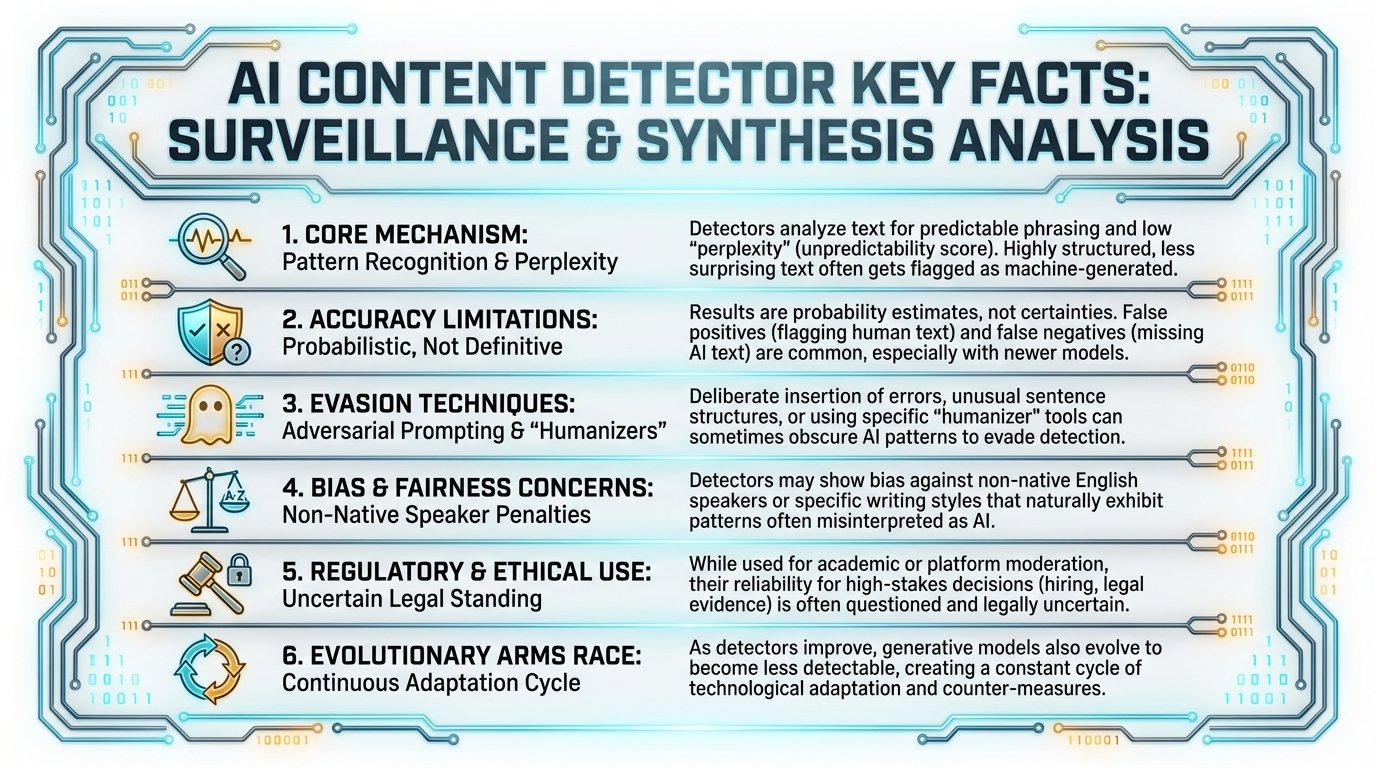
AI content detectors analyze statistical patterns in text, measuring vocabulary entropy, sentence structure, semantic coherence, and stylistic consistency to distinguish human writing from machine output.
The pattern recognition approach
Every detector runs on the same basic premise: LLMs produce text with predictable statistical signatures, and human writing doesn't. Human writing is messier - more variation in word choice, irregular sentence lengths, transitions that don't always follow logically from what came before, the occasional tangent that goes nowhere particularly useful.
The leading ai content detectors - GPTZero, Copyleaks, Turnitin, Originality.AI, Winston AI - each trains proprietary models on datasets of known AI and human writing, then scores incoming text against those probability distributions. Flagged passages get flagged. The math, in theory, is sound.
Here's the part that should give everyone pause. These detectors are themselves AI systems trying to catch other AI systems - and that circular dependency isn't just philosophically awkward. It's a structural vulnerability. One that's already being exploited, systematically, by people who read a single Reddit thread about it.
Claimed accuracy vs. independent testing
Vendor marketing is optimistic. Independent testing, less so.
ToolClaimed AccuracyIndependent False Positive Rate
Winston AI99.98%1-2% (Bloomberg) Copyleaks99.12%1-2% (Bloomberg) GPTZero99%1-2% (Bloomberg) Turnitin98%Not independently verified Originality.AI98.2%Not independently verified
Bloomberg tested these ai content detectors and found false positive rates of 1-2% - a figure that sounds almost reassuringly small until you do the math on any real institution. A university processing 50,000 papers per semester at a 1% false positive rate is generating 500 wrongful accusations of cheating per semester, not because of any actual fraud, but because the tool is wrong about one in every hundred students. Consistently. Every cycle.
3. The ESL bias nobody talks about enough
The most damaging finding in AI detection research comes from Stanford. Researcher Weixin Liang found that 61.22% of non-native English essays were falsely flagged as AI-generated across every detector tested.

A 49-point gap
When those same ESL writers improved their English proficiency, the false positive rate dropped to 11.77%. A 49-percentage-point swing - driven entirely by writing quality, not by any actual AI use. The detectors weren't catching AI. They were catching imperfect English, and calling it fraud.
950,000 international students are currently enrolled in U.S. universities. That's not a small population to get wrong. Students who paid premium tuition - in many cases more than domestic peers - to study in English are disproportionately the ones being accused of cheating by tools their institutions deployed in the name of academic integrity. There's something deeply off about that math.
Beyond the classroom
The false accusation problem doesn't stop at campus gates. Hiring managers using ai content detectors free tools to screen writing samples are, by the numbers, discarding qualified candidates whose first language isn't English. Content moderators flagging user-generated text as synthetic are silencing real people. Newsrooms running freelancer copy through detectors - and there are newsrooms doing exactly this - are killing legitimate stories.
None of this is speculative. These outcomes follow directly, mathematically, from the documented bias rates across every major detection tool. The bias isn't a bug someone is actively fixing. It's baked into how the tools define "humanness" in the first place.
4. The detection industry as a business
AI detection is now a $580 million market projected to hit $2.06 billion by 2030, growing at 28.8% annually. That growth creates incentives that don't always align with accuracy.

GPTZero's trajectory
GPTZero hit $24 million in annual recurring revenue by 2025 - a 253% year-over-year jump from $6.8 million - while achieving profitability on just $3.5 million in raised capital and scanning 600 million documents across 4 million registered users. Those are genuinely impressive numbers for a company that, in a more skeptical environment, would need to answer harder questions about the accuracy of its core product.
Impressive and uncomfortable, simultaneously. GPTZero now has a real financial incentive to market detection as reliable, even as universities ban the technology and federal lawsuits accumulate. Honestly? A tool that marketed itself as "right most of the time, but will occasionally derail an innocent student's academic career" doesn't reach $24 million ARR. So the incentives and the facts don't quite line up.
Who profits from the trust crisis
The detector industry exists because trust eroded. It also depends on that erosion continuing. If AI companies solved provenance tomorrow - actual watermarking, enforceable metadata standards, something substantive - the detector market would shrink to nearly nothing. That's not a conspiracy; it's just how markets work.
The resulting ecosystem is genuinely strange. AI companies build tools that generate synthetic content; detector companies build tools to catch it; AI companies improve their models to evade detection; detector companies retrain and claim higher accuracy. Round and round. The only guaranteed beneficiaries are the companies selling infrastructure on both sides of the arms race - picks and shovels, in both directions, simultaneously.
5. The legal reckoning
False accusations are now generating lawsuits. At least four federal cases were filed against universities between September 2024 and February 2025 over ai content detector errors.
Cases that changed the conversation
Yale School of Management expelled a student in February 2025 based on a GPTZero flag; the resulting lawsuit alleges both tool bias and a coerced false confession - a detail that should make any administrator using these tools deeply uncomfortable. The University of Minnesota expelled PhD candidate Haishan Yang in January 2025 after a remote exam was flagged. Hingham High School. Adelphi University. The cases kept coming.
The pattern across all of them is consistent, and it's worth stating plainly. Institution deploys detector. Detector flags student. Institution treats the flag as proof rather than signal. Student faces severe consequences with limited recourse. Every step in that chain reflects a choice - not an inevitability.
Institutional retreat
Vanderbilt. UT Austin. UCLA. UC San Diego. Michigan State. Penn State. All of them have already banned or deprecated AI detection tools - not quietly, but after recognizing legal and ethical exposure that made continued use indefensible. Their collective pullback says something the vendors won't: the risk of wrongly accusing an innocent student outweighs whatever benefit you get from occasionally catching someone who actually used AI.
6. What trust infrastructure could actually look like
Detection-after-the-fact is a losing strategy. The real solution involves building verification into content at the point of creation, not trying to reverse-engineer it after publication.

Watermarking and provenance standards
C2PA - the Coalition for Content Provenance and Authenticity - takes a fundamentally different approach. Rather than trying to detect AI after the fact, the standard embeds cryptographic metadata into content at the moment of creation, establishing a chain of custody that travels with the file through every downstream copy and distribution step. When AI generates something, that fact gets encoded at the source.
Adobe, Microsoft, Google, and OpenAI are all members. The standard works reasonably well for images, video, and audio. Text is harder - text gets copied, reformatted, pasted into new documents, stripped of its original metadata - and that's where the approach starts to strain against practical reality.
The gap between vision and reality
Watermarking works only if every major AI provider implements it consistently and every platform down the chain respects the metadata instead of stripping it. Neither condition is anywhere close to true right now. Most social media platforms strip metadata on upload - not maliciously, just because provenance was never designed into the pipeline. Most text editors don't preserve it either. The infrastructure simply isn't there.
So we're stuck in the awkward middle: detection tools that don't reliably work, provenance standards that aren't universally adopted, and four million monthly searchers looking for certainty that doesn't exist yet. I'm not sure how optimistic to be about the timeline - these are coordination problems, and coordination problems are slow.
"The fundamental problem isn't detecting AI. It's that we built an information ecosystem with no authentication layer, and now we're trying to bolt one on after the fact."- Weixin Liang, Stanford University researcher on AI detection bias
7. What this means for content teams
If you're running a content operation, the detector landscape has direct implications for your workflow, your hiring process, and your editorial standards.
Practical takeaways
Don't use ai content detectors free tools as a pass/fail gate for freelancer submissions - the false positive rates mean you'll reject good human writers while sophisticated AI-assisted content sails through undetected anyway. Process-based verification works better: outlines, drafts, revision history, a phone call. Actual evidence of how work happened, rather than a probability score from an algorithm with a documented bias against non-native English speakers.
If a competitor is marketing "AI detection scores" as proof that their content is "100% human-written," they're making a claim that's unverifiable with any current technology. Full stop. Focus instead on quality signals that readers and search engines can actually measure - depth, specificity, original data, genuine expertise. Those things are real. The detection score isn't.
The consumer trust numbers from the 2025 Checkr survey are worth sitting with: 41% of consumers trust AI search results more than paid ads, but only 12% are comfortable with fully AI-generated news. What your audience actually wants is AI-assisted efficiency combined with human judgment and real accountability. That's the positioning that holds up; the "we detected it's human!" angle doesn't.
8. Frequently asked questions
Are AI content detectors accurate enough to rely on?
No. Independent testing by Bloomberg found 1-2% false positive rates despite vendor claims of 98-99% accuracy. Stanford research showed 61% of ESL essays were falsely flagged. No current detector is reliable enough for high-stakes decisions like expulsion or termination.
What do AI content detectors look for in text?
They measure statistical patterns including vocabulary entropy, sentence structure regularity, semantic coherence, and stylistic consistency. AI-generated text tends to be more uniform and predictable than human writing, and detectors score text against those probability distributions.
Can AI-generated content pass detection tools?
Yes. As language models improve, their output increasingly resembles human writing patterns. Light editing, paraphrasing, or using less common models can reduce detection rates significantly. The arms race between generators and detectors favors generators over time.
Why are universities banning AI detectors?
Vanderbilt, UCLA, UT Austin, and others banned detectors after recognizing false accusation risks. At least four federal lawsuits (2024-2025) targeted universities for AI detector errors, creating legal liability that outweighs detection benefits.
What alternatives exist to AI detection tools?
Process-based integrity measures work better: requiring outlines, drafts, and revision history. Long-term solutions include C2PA provenance standards and AI watermarking. These verify content at creation rather than trying to reverse-engineer authenticity after publication.
9. The bottom line
Four million monthly searches for AI content detectors represent a real, measurable trust crisis. People want verification tools because the internet feels less reliable than it did three years ago. That instinct is correct.
What the tools available today can't do is actually deliver what those searchers want. The gap between demand and reliability is where this whole story lives; the detectors aren't incompetent exactly, but they're being asked to solve a problem that detection was never going to solve cleanly. Until provenance infrastructure catches up, the honest answer is uncomfortable: we don't yet have a technological solution that matches the scale of the problem.
For content teams: invest in process over tools, quality signals over detection scores, transparency over purity claims. The trust crisis is real - genuinely, structurally real, not a moral panic. The quick fix isn't, though. Not yet, and probably not soon.

Write better. Rank higher. Save time.
Article Lab helps you research, plan, and optimize content that actually performs.
Article Lab Team
Writing on content strategy, SEO methodology, and the architecture behind research-driven publishing.