

1. The Numbers Behind SEO's Structural Break
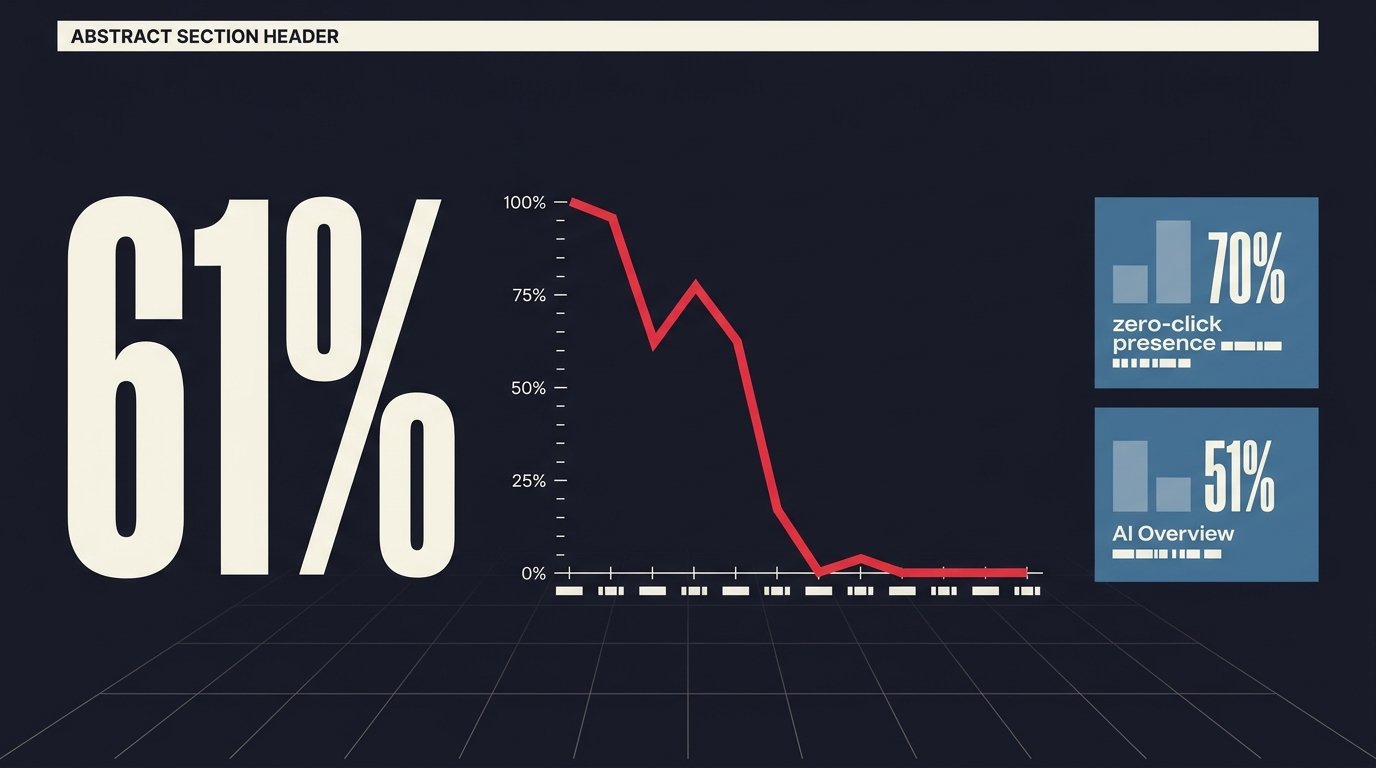
Organic click-through rates have collapsed 61% on queries where AI Overviews appear, zero-click searches exceed 50%, and the relationship between AI and SEO is fracturing the keyword-centric era in real time.
Start with the number that actually matters. Google's AI Overviews showed up in 6.5% of U.S. queries at the start of 2025; by mid-year, that figure had climbed to somewhere between 11 and 13 percent - a near-doubling in a matter of months, not the kind of growth curve you pencil into a gradual rollout plan. Not incremental. Structural.
What the Seer Interactive Study Revealed
Seer Interactive ran the numbers: 3,119 informational queries, 42 organizations, 25.1 million organic impressions tracked from June 2024 through September 2025. On queries where an AI Overview fired, CTR fell from 1.76% to 0.61%. Brutal math.
The second figure is the one worth sitting with. Queries that didn't trigger AI Overviews still saw CTR drop 41%. That's not a feature rollout problem - that's users changing how they relate to search results entirely.
- 61% CTR collapse on queries with AI Overviews
- 41% CTR decline even on queries without AI Overviews
- 50%+ of all searches now end without a click
- 11-13% of U.S. queries currently trigger AI Overviews, up from 6.5%
This Isn't Another Algorithm Tweak
Penguin reshuffled rankings. Panda punished thin content. Both updates assumed users would keep clicking through to actual websites - that was the whole model.
AI Overviews pull the floor out from under that assumption: users get their answer, close the tab, and never reach your site. The journey that keyword strategy was engineered around doesn't work the same way anymore. Navigating the new dynamic between AI and SEO requires a completely different mental model than the one that served the past twenty years.
2. Why Keyword Density Dies Inside an AI Overview
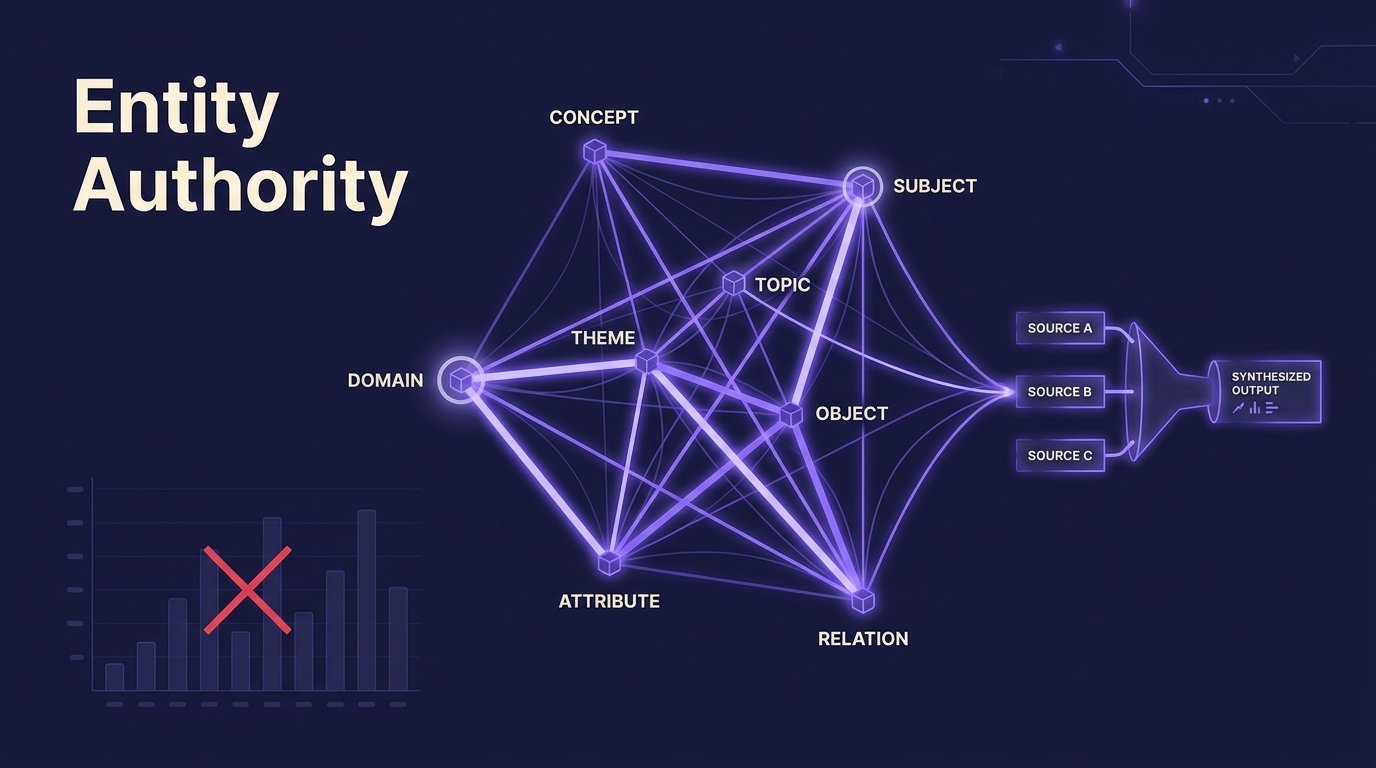
Google's AI Overviews don't rank individual pages; they synthesize content from multiple sources based on entity relationships and semantic authority, making keyword density irrelevant to selection.
For two decades, the game was simple: find a keyword, build a page around it, earn some links, climb the rankings. Search engines scored individual pages, more or less independently. AI Overviews break that model at the foundation.
How AI Source Selection Actually Works
Two Google patents (US11768837B1 and US8577893B1) spell out the shift directly. Ranking weight now turns on contextual text surrounding links and semantic entity positioning within vector space - which sounds dense, but the practical implication is simple: Google's AI doesn't care how many times "best running shoes" appears on your page. It cares whether your content actually understands the topic.
The system scrapes fragments from multiple sources, assembles them into a synthesized answer, and drops it above every traditional result. Not competing for a position anymore. Competing to be quoted.
- Entity relationships matter more than keyword frequency
- Contextual authority outweighs exact-match optimization
- Synthesis from multiple sources replaces single-page ranking
Citation Now Beats Position One
Seer's data inverts the old hierarchy cleanly. Pages cited inside an AI Overview pulled 35% more organic clicks and 91% more paid clicks than uncited pages sitting directly below it.
MetricCited in AI OverviewPosition 1 Below Overview Organic click boost+35%Baseline Paid click boost+91%Baseline Optimization approachEntity-rich, quotable contentTraditional keyword targeting
Citation is the new position one. Twenty years of "rank first" logic just got flipped.
From Ranking Pages to Becoming Quotable
Topic cluster architectures outperform keyword-silo structures by 38% in organic traffic, per SEMrush's analysis.
Interconnected, entity-rich content beats pages built around isolated search terms - and that gap widens as AI systems get better at tracing relationships between connected pieces of information. The question has changed.
It used to be "how do I rank for this keyword?" Now it's "how do I become the source an AI trusts enough to quote?
3. Which Industries Are Getting Hit Hardest
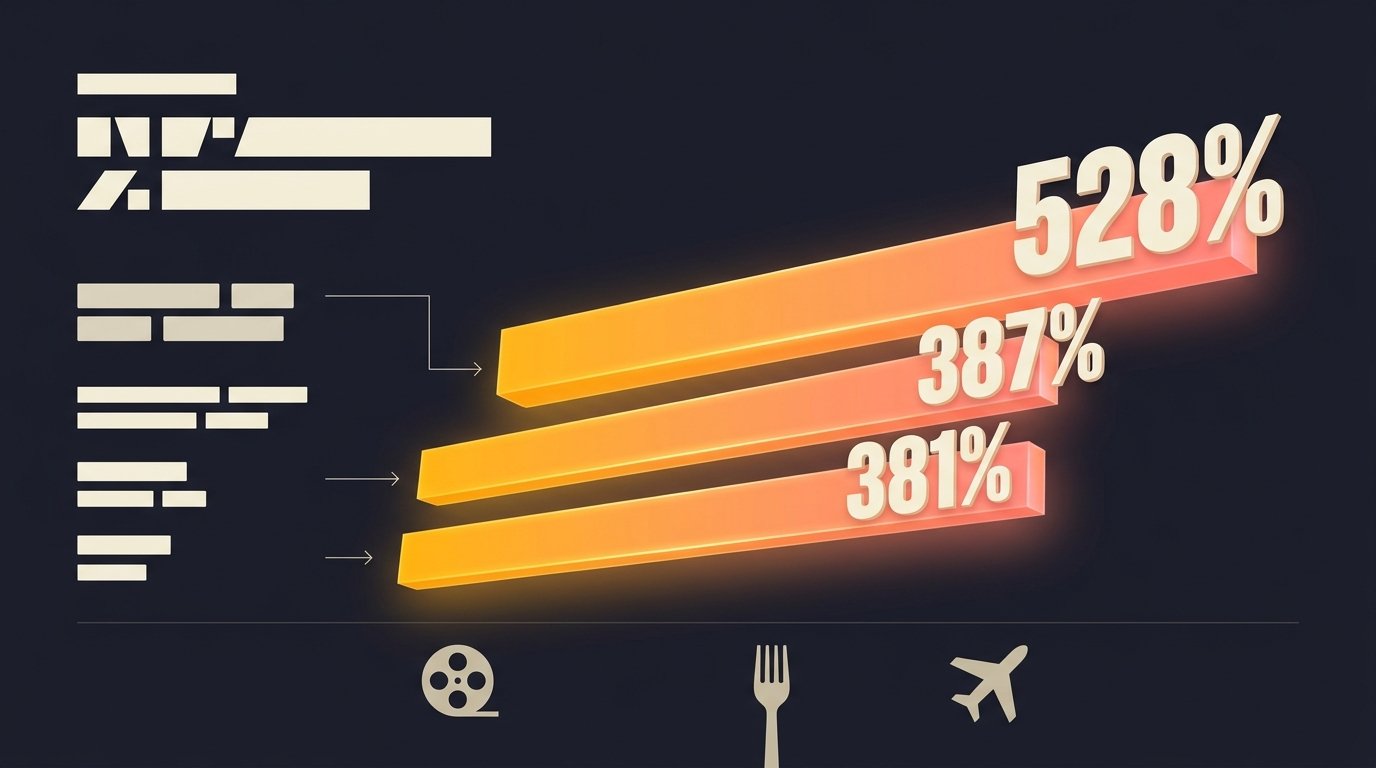
Entertainment, restaurant, and travel verticals saw AI Overview penetration spike 528%, 387%, and 381% respectively after Google's March 2025 core update, while other verticals were already saturated.
The disruption is not uniform. Some verticals are near-saturated; others are still running mostly on traditional ranking logic. That gap - and it's a real one - makes any universal SEO playbook actively misleading right now.
Vertical Penetration After March 2025
Google's March 2025 core update hit different verticals very differently (which, honestly, is the whole story in three words). Healthcare and education were already saturated well before March. Entertainment, restaurants, and travel absorbed the biggest new wave - 528%, 387%, and 381% increases, respectively.
VerticalAI Overview IncreasePre-Update Status Entertainment+528%Moderate presence Restaurants+387%Low presence Travel+381%Low presence HealthcareAlready saturatedHigh presence EducationAlready saturatedHigh presence
Companies in the same space are now operating under completely different algorithmic conditions depending on which vertical they sit in. Generic SEO advice has become actively misleading.
Small Publishers Are Getting Squeezed
Chartbeat's data tells the painful mid-tier story: publishers in the 1,000-10,000 daily pageview range lost 60% of their search referral traffic over two years. Too small to weather platform fragmentation across multiple channels. Even among the best ai seo tools 2025, some are too established to just pivot into a narrow specialist lane.
Massive publishers diversify. Narrow specialists go deep enough on a single topic to become citation-worthy. Publishers caught in the middle get squeezed from both directions, and keyword strategy doesn't fix any of it.
Check your vertical first: Before applying any generic SEO advice, verify your own industry's AI Overview penetration rate. The playbook for a travel site looks nothing like the playbook for a B2B SaaS company right now.
4. What the Best AI SEO Tools 2025 Actually Optimize For
Answer Engine Optimization (AEO) replaces keyword targeting with three concrete shifts: entity clustering, structured data markup, and citation-based measurement.
Call it AEO, call it whatever you want - the label is less interesting than the mechanics. The core shift in AI and SEO is that practitioners are replacing keyword-density optimization with a different architecture: entity clustering, structured data, and a different definition of what "success" even means in search.
Shift 1: Entity Clusters Over Keyword Silos
Traditional architecture grouped pages around individual keywords. Entity clustering groups them around topics - pillar pages connecting to supporting articles through semantic relationships, not keyword anchors.
That 38% organic traffic advantage from SEMrush's analysis isn't magic. AI systems trace relationships between connected entities better than they parse isolated keyword-optimized pages. Structure the connections correctly and you become legible to the system.
- Map entity relationships before writing, not keyword lists
- Build internal links along topic relationships, not keyword anchor text
- Pillar content covers broad entities; supporting content handles specific facets
- Semantic depth on a topic matters more than coverage breadth across many keywords
Shift 2: Schema Markup as AI Infrastructure
Schema.org markup tells AI systems what your content covers, how your entities relate, and when the information was last updated. Without it, you're asking an AI to guess your relevance. With it, you're handing it a citation-ready source.
Local SEO makes this concrete. Google Business Profile freshness - reviews, posts, consistent NAP data - now outweighs traditional on-page keyword work. Trust signals have taken over from keyword anchors.
- FAQ schema for question-answer content blocks
- Article and Organization schema to establish entity identity
- Freshness signals updated regularly, since recency affects AI source selection
Shift 3: Measure Citations, Not Rankings
The old KPI was your ranking position. The new one is how often you get cited across AI platforms. AI-referred traffic converts at 14.2% versus 2.The best ai seo tools 2025 achieve 8% for standard organic - roughly a 5x efficiency gap, which is genuinely striking.
One catch: AI-sourced traffic is still 0.15% of global internet traffic, while organic search sits at 48.5%.
The conversion rate is real; the volume is not, at least not yet. Teams doing this well track both channels and don't torch their traditional SEO investment chasing a 0.15% slice of the pie.
AI referral conversion rate
14.2% (vs. 2.8% organic)
AI share of global traffic
0.15% (vs. 48.5% organic)
AI traffic growth
+796% (Jan 2024 to Dec 2025)
- Track AI citation frequency across Google AI Overviews, ChatGPT, and Perplexity separately
- Monitor AI-referral conversion rates as a distinct channel
- Don't abandon ranking tracking since traditional search still drives the vast majority of traffic
5. Frequently Asked Questions
The most common practitioner questions about AI and SEO, answered without the vendor spin.
Are traditional SEO fundamentals actually dead?
No. Domain authority, content quality, and backlinks still shape which sources AI systems pull from. Google confirmed that AI Overviews draw from the same organic index as standard results. The fundamentals matter - they just don't guarantee visibility the way they once did.
Can I optimize for all AI platforms at once?
Not really. Only 12% of sources cited by ChatGPT, Perplexity, and Google Gemini actually overlap. ChatGPT tends to favor depth and authority; Google Overviews lean toward concise, directly responsive content. You need different approaches for each, which is inconvenient, but that's where things are.
How much AI-referral traffic should I realistically expect?
AI-sourced traffic converts at 14.2% versus 2.8% for organic - compelling efficiency. But it's 0.15% of global internet traffic, versus organic's 48.5%. Solid conversion rate, unimpressive reach. Don't rebuild your entire strategy around it until the volume actually materializes.
What red flags should I watch for in AI SEO vendors?
Watch for anyone claiming proprietary AI ranking secrets or guaranteed AI Overview placement. Google has confirmed no special indexing tier exists for Overviews. Equally suspect: anyone telling you to discard your traditional SEO work entirely. Both are selling you something.
Which platform drives the most AI referral traffic?
ChatGPT holds 77.97% of AI-referral visits. Perplexity is at 15.10%, Google Gemini at 6.40%. Heavily concentrated - and the shares keep shifting, so check those numbers again in six months.
Is [keyword research](https://www.growth-memo.com/p/death-of-the-keyword) still worth doing?
Yes. The purpose has shifted: keyword research now tells you what topics and entities your audience actually cares about, not which phrases to repeat on a page. Think of it as intent mapping. The research is still worth doing; the output just gets used differently now.

Write better. Rank higher. Save time.
Article Lab helps you research, plan, and optimize content that actually performs.
Article Lab Team
Writing on content strategy, SEO methodology, and the architecture behind research-driven publishing.